(1)
She tightened her arms around Raju’s waist and whispered, her voice low and deliberate, “I’ve been starving for a year and a half. Slowly… enter me. Let your body sink into mine and satisfy me.”
Raju slipped out of her embrace and began unbuttoning her clothes. This was the first time he would actually sleep with her. He had come to her five or six times before. Each time, they talked—sometimes for hours—and each time she let him leave untouched. Yet she always paid him in full.
Three thousand rupees. Not a paisa less. Raju had several clients like that, though this one puzzled him. Every woman he met fell into a category. Some were content with foreplay alone, others demanded things he preferred not to think about afterward. But a woman who found satisfaction in nothing but conversation? That was new.
For days, it had bothered him—though he dismissed it as hesitation. Many women took time before allowing someone into their bodies. He didn’t question it further. Questioning clients was bad for business.
He tore open the condom packet. She was already lying on the bed, eyes unfocused, breath uneven. Before he could begin any foreplay, she pulled him toward her, guiding him inside with surprising urgency.
Forty-five minutes later, when it was over, Raju wiped the tears from her eyes. At Chandrani Sen’s agency, Raju was one of their highest-priced assets. His stamina was legendary; his rates reflected it. Most of his clients were ‘nymphomaniacs’—women who expressed desire through scratches and bites that left his body marked. Raju never complained. Money demanded endurance.
She kissed his lips softly. “Is it over?” she asked.
He nodded. “Do you need more?”
She pressed him down against her body, crushing him with an intensity that felt excessive. “No. Stay like this. Just for a while.”
Raju rested his face against her shoulder. That was when he felt it. A crushing pressure wrapped around his torso—tight, relentless, inhuman. It felt as if an elephant or a python had coiled itself around him. His breath caught. The room began to darken at the edges of his vision.
(2)
The next morning, D.K. leaned back in the driver’s seat and grinned. “Any idea where we’re going?”
Shubho buckled his seatbelt. “New case, obviously. But what kind?”
D.K.’s grin widened. “Do you know what a gigolo is?”
Shubho shook his head. “Heard the word somewhere. Is it some tribal dish?”
D.K. burst out laughing. “Your intelligence amazes me! A gigolo is a man who satisfies women—for money.”
Shubho stared at him, eyes wide. “You mean… a male prostitute?”
The car slowed to a stop in front of a two-storey building. A large signboard hung above the entrance: FRIEND FINDER.
“I’ve seen ads for this place in the papers,” Shubho said. “They help people find companions—for a fee.”
“That’s the public story,” D.K. replied. “Behind it, they run a quieter business. Male prostitution. Their clients are wealthy women from influential households.”
They stepped inside. To the left was a curtained enclosure—probably the office. D.K. lowered his voice. “May I come in?”
A melodious voice answered from within. “Please do. I’ve been expecting you.”
They entered. The room looked less like an office and more like a greenhouse. Plants lined the walls, crept along the windows, filled every corner. A large table stood in the center, topped with an old-fashioned landline telephone. Behind it sat a woman in her early forties, tastefully made up, tapping away at a laptop. She looked quite elegant.
“Why are you standing?” she asked with a polite smile. “Please, sit.”
They took their seats. “I called you,” she said. “My name is Chandrani Sen.”
“You mentioned you knew of me,” D.K. said. “And this is Shubho, my assistant.”
She glanced at Shubho, amused. “I’ve only read about detectives having assistants in novels. First time seeing one in real life.”
D.K. got straight to the point. “So, what’s the case? Why did you call us?”
“One of our employees has been missing for two days,” Chandrani said. “I need you to find him.”
“I see,” D.K. nodded. “First, tell me about your agency in detail. It will help me work the case.”
Chandrani folded her hands. “Our workers operate independently. Each has different rates. Customers pay an entry fee to book them—online or offline. Once paid, we share the worker’s profile, effort level, and rates. The customer chooses, and we provide the contact number. They arrange the rest. We don’t take commissions from the workers like other agencies do. However, certain popular workers boost our business significantly.”
“What if a worker services a new client outside your system?” D.K. asked.
“We have safety measures. Generally, clients don’t contact workers directly. If we find out otherwise, a polite but firm call to the client usually resolves it.”
D.K. nodded. “Now, tell me about the missing man.”
“Not all clients are well-behaved,” Chandrani sighed. “Some find satisfaction in inflicting pain—scratches, bites, violence. We have specialists for such clients. Raju is one of them. He’s expensive, high-energy, and very popular.”
She continued, “I last spoke to him the night before last. Since then, his phone has been off. I assumed he quit—people don’t last long in this line of work. But this morning, his brother came looking for him. Their father is on his deathbed. Raju isn’t answering. That’s when I called you.”
“Where did Raju live?”
“A mess in Puranopotti. His roommates say he left two days ago and never returned.”
“Give me his photo and number,” D.K. said.
Chandrani opened a drawer. “What’s your fee?”
“Five thousand for expenses upfront,” D.K. said. “After that, it depends. If he’s just run away, I’ll charge another ten. If it’s a crime—kidnapping or murder—it’ll be another twenty.”
Chandrani wrote the cheque immediately.
Walking out, Shubho asked, “Where do we start?”
D.K. studied the number. “It’s an Airtel number. Do you have Arindam’s contact?”
“Arindam Roy from customer care?”
D.K. nodded. “He changed his number recently. Get it from him. Send him Raju’s number and ask for the last active tower location.”
On the drive back, Shubho got a reply. “The phone was switched off in the New Market area.”
D.K. frowned. “That doesn’t fit. This isn’t a simple runaway case.”
“Why not?”
“New Market is in the opposite direction of the bus terminus or railway station. If he wanted to flee the city, he wouldn’t go into the heart of it.”
“Maybe he met someone there?” Shubho suggested. “A love affair? Maybe he ran off with a lover to start fresh?”
“Or maybe,” D.K. mused, “he met a representative from a rival agency.”
D.K. stopped the car near Shubho’s house. “Too many probabilities. We need his call records. Give me Arindam’s number. I’ll come to your place tomorrow morning.”
Shubho got out, thinking, ‘And so begins the Gigolo Mystery.’
(3)
The next morning, D.K. called Shubho out.
“Any news?” Shubho asked.
“I traced the last incoming call to Raju’s phone,” D.K. said. “It came from a fake ID, a burner number. Location: New Market area. But this number has called him multiple times before. First call was on the 15th of last month. Likely a client. We’re going back to Chandrani.”
“Is the number active?”
“No. It went dead the same day Raju disappeared.”
“You think he ran off with this client?”
“Everything is a guess until we get details.”
At the agency, Chandrani shook her head. “We don’t keep IDs for client safety. This booking was via a social networking site. We never met her.”
D.K.’s eyes lit up. “Show me the profile.”
The profile name was ‘Angel Jasmine’. The display picture showed a half-clad foreign woman.
“This will work,” D.K. said.
Back in Shubho’s room, D.K. sat at the computer.
“New Market keeps coming up,” Shubho said. “We should just go there and search. Raju might still be there.”
“Going without intel is like throwing stones in the dark,” D.K. muttered, scrolling through ‘Angel Jasmine’s’ friend list. He pointed at a profile. “Recognize him?”
Shubho looked at the picture: a middle-aged Caucasian man with a French-cut beard standing on a beach. A Spider-Man tattoo coiled around his forearm. Name: K. N. Brian.
“No. Who is he?”
“Kevin Neil Brian,” D.K. said quietly. “Australian zoologist. Disappeared years ago while researching something classified. Police never found him.”
“Does he have a connection to our case?”
“Maybe. Maybe not. But coincidences are rare.” D.K. typed rapidly. “I pulled the IP address of the computer used to access the ‘Angel Jasmine’ account. It’s a cyber café in New Market owned by a Chandan Das.”
“New Market again,” Shubho said. “Let’s go.”
They found the cyber café. It was small and cramped. A young man sat behind the counter.
“Are you Chandan Das?” D.K. asked.
“Yes. What’s the matter?”
“We are from the Detective Department. We need information.”
The boy paled. “What information?”
“On the 13th of last month, around 6:30 PM, a woman used one of your computers. We need to know about her.”
“Sir, that was weeks ago! So many people come here…”
“A woman used your center for illegal activities,” D.K. bluffed sternly. “If you don’t help, we’ll have to arrest you as an accomplice.”
“Wait! I have CCTV footage!” Chandan stammered.
He pulled up the recording. They saw a woman sitting with her back to the camera. Suddenly, for a brief moment, she turned her head. D.K. froze the frame and zoomed in.
“I’ve seen this face,” D.K. murmured. “But where?”
“A criminal?” Shubho asked.
“No. Likely a victim.” He turned to Chandan. “Do you know her?”
“No, but I’ve seen her coming out of Rabindra Apartments a few times. She’s quite striking, so I noticed.”
D.K. printed the image.
On the way back, Shubho said, “We are overcomplicating this. We should have raided Rabindra Apartments immediately. Raju might still be there.”
“If it were that simple, Chandrani’s informers would have found him,” D.K. replied. “They failed. That means this isn’t a general case. It’s likely a crime. Step by step, Shubho. We need to be safe before we find the victim.”
(4)
The next morning, D.K. slammed a newspaper clipping onto Shubho’s desk. “Recognize her?”
It was an old article, but the photo was the same as the woman from the cyber café.
“That’s her!” Shubho exclaimed. “Why was she in the paper?”
“Read it.”
Shubho read the report. Kevin Neil Brian, an Australian geneticist, vanished from his lab along with his Indian research assistant, Trishna Chakraborty. The lab was locked from the inside. Nothing was stolen except some important research papers and a large Plaster of Paris sculpture.
“So, these disappearances are linked?” Shubho asked, horrified.
“Not just two. Several people have vanished like this across the globe over the last few years.”
“What was Brian researching?”
“I’ve sent a query to a detective friend in Australia. For now, get ready. We are going to Rabindra Apartments.”
Rabindra Apartments was an aging concrete block with faded paint and narrow balconies that overlooked the market road. The security guard studied the photograph D.K. held out. “Yes,” he said after a moment. “She lives here. Fifth floor. Flat 507.” “And this man?” D.K. asked, showing Raju’s picture. The guard nodded. “He came often. Must’ve been her boyfriend.” “When did you last see him?” “Five days ago. Evening.” “And when did he leave?” The guard hesitated. “I… didn’t see him leave.” D.K. held his gaze. “Did anyone?” “I work day shift. The night guard might know.”
D.K. lowered his voice, his tone dangerous. “He didn’t leave. He is still in that room. Likely dead.” The guard gasped. “Ram! Ram! Are you police?” “Yes,” D.K. lied smoothly. “We need to search the room. Do you have a duplicate key?” “Yes… follow me.” “Open the flat,” D.K. said quietly. “Discreetly.”
Inside, the apartment was surprisingly elegant. Framed photographs lined the walls. Designer clothes hung neatly from a rack. The bed was covered in a fresh white sheet. And along one wall—several large plaster-of-paris sculptures stood arranged in a row. The air smelled faintly chemical. “Search carefully,” D.K. instructed. They split up.
Shubho crouched near the bed and frowned. “D.K.—look at this.” On the floor, near the bedframe, was a patch of white, semi-dried residue—thick, slightly crystalline. Shubho smirked nervously. “Found your gigolo evidence.” D.K. didn’t smile. He knelt and examined it closely, using a wooden stick to scrape a sample into a plastic pouch. “If you think that’s what it is,” he said calmly, “you’ve led a very sheltered life.” He pointed to the surrounding area. The residue wasn’t splattered—it pooled unnaturally. “No human produces this volume,” D.K. said. “Not like this.”
They moved to the bathroom. Near the drain, D.K. picked up something deflated and twisted. “A condom,” Shubho said. “Yes,” D.K. replied. “With blood.” Shubho swallowed. “So she was a virgin? Or—” “Or something tore him open,” D.K. said quietly. The implication hung heavy.
Back in the bedroom, D.K. stood before the plaster sculptures. Too many of them. For a single woman. And each large enough to conceal something. He tapped one gently. Hollow. “Interesting,” he murmured.
When they left, D.K. turned to the guard. “If she asks, you saw nothing. One word, and you’ll be arrested.” The guard nodded frantically.
On the way back home, Shubho broke the silence. “I think we’re looking in the wrong place. Raju is gone.” “No,” D.K. said firmly. “We are in exactly the right place. Raju is in that flat.” Shubho looked at him in disbelief. “Are we crazy? We searched everywhere! He’s not a mouse to hide in a hole.” D.K. chuckled grimly. “If you have the eyes to look, many things can be found.”
(5)
The lab report arrived the next morning. D.K. called Shubho immediately. “The white residue,” D.K. said, his voice grave, “is an enzyme. It’s produced by lower-order insects to digest food.” “How many insects would it take to produce that much?” Shubho asked. “Just one,” D.K. replied. “But it would have to be the size of a creature from the Jurassic era. Based on the quantity, this creature weighs at least sixty kilos.”
Shubho felt a chill run down his spine. “And the blood found in the condom?” “It matches Raju’s blood group,” D.K. confirmed. “So… she keeps a sixty-kilo insect in her apartment? And that’s what happened to the missing men?” “Something like that,” D.K. mused. “It seems Dr. Brian either found or created a prehistoric insect. Trishna likely used the creature to kill him and now keeps it as a pet, feeding it fresh victims.”
“But where is it hiding?” Shubho argued. “A sixty-kilo insect isn’t small. And what about the bones? Even a giant insect can’t digest human bones.” “Wait and see,” D.K. said enigmatically. “All will be revealed.”
(6)
Two days passed without any contact. Then, D.K. suddenly appeared at Shubho’s room with a strange urgency.
“Get ready,” he ordered. “We’re going to the Municipal Corporation office, and then to Rabindra Apartments.”
“Is the mystery solved?”
“Solved? Yes. Now we just have to face the culprit. Raju is dead, Shubho. He’s been eaten.”
At the Corporation office, D.K. spoke to the Vector Control department. He returned with two men carrying massive fogging machines and tanks of liquid spray strapped to their backs. Shubho whispered, “Why are they coming with us?”
D.K. grinned. “I told them there’s a severe mosquito outbreak at the apartment. Since we are dealing with a ‘prehistoric mosquito,’ regular spray won’t work. We need heavy machinery.”
They arrived at Rabindra Apartments. This time, the local Police Officer-in-Charge (OC), Mr. A. Bhargav, was waiting for them in the lobby along with the security guard.
D.K. introduced Shubho.
“Interpol contacted us last night,” Bhargav said nervously as they headed for the stairs. “They warned that a dangerous creature was brought to India from Australia. I can’t believe nobody noticed it.”
“You won’t see it unless you know how to look,” D.K. warned. “Stay alert. It can attack at any moment.”
(7)
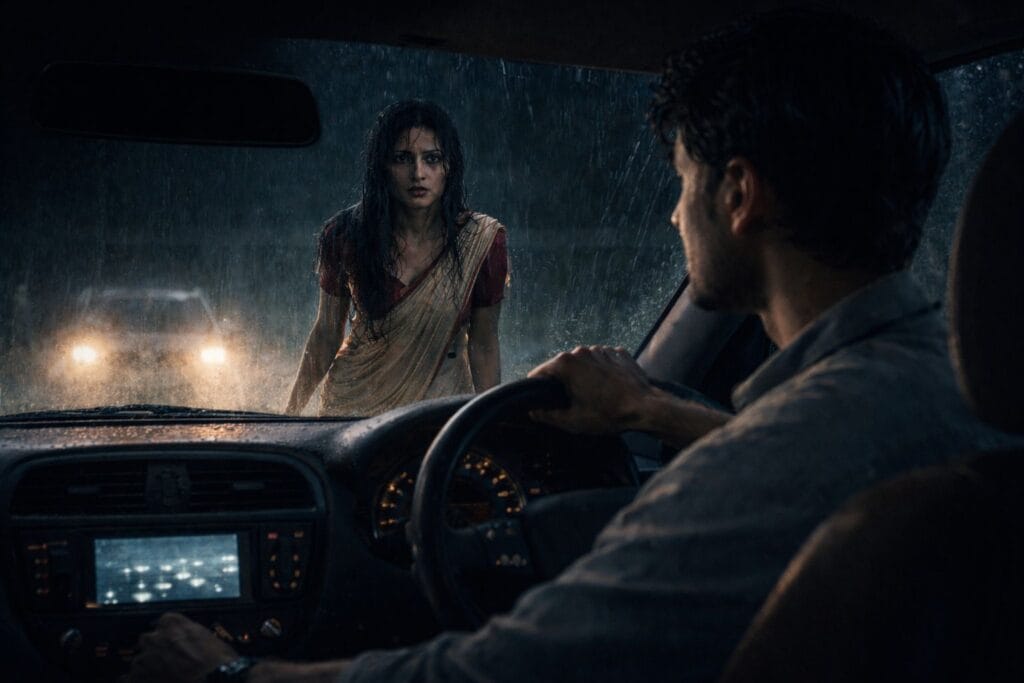
Trishna opened the door of Flat 507. Seeing the police officer and men with strange machines, she looked startled.
“What is this?” she asked.
D.K. stepped forward, assuming a bureaucratic tone. “Municipal Corporation, Madam. There’s a severe Dengue outbreak in the building. Mandatory spraying. Government orders.”
“But there are no mosquitoes here,” Trishna protested, blocking the way.
“We’ll be the judge of that,” D.K. said, pushing past her into the room. The others followed. D.K. sat on the sofa uninvited.
“Why are you sitting instead of spraying?” she demanded.
D.K. smiled. “We will spray. But first, a little chat. If I’m not mistaken, your name is Trishna Chakraborty, former assistant to Australian zoologist Dr. Kevin Neil Brian.”
She stiffened. “No. I am Indrani Roy. I’ve never been to Australia.”
D.K. placed the printed photo on the table. “We hacked your ‘Angel Jasmine’ account. We have your chats with Brian. We have the IP address from the cyber café. We have CCTV footage. Don’t lie.”
Her demeanor shifted. “Even if I am Trishna, what is my crime?”
“Murder,” D.K. said calmly. “Dr. Brian in Australia. Men in Tanzania, Egypt, and now India. Specifically, Raju.”
“Why would I kill them?” she shouted, her eyes turning red. “Where is the motive? Why would I increase my own risk for nothing?” “Feeding time,” Shubho blurted out. “You keep a giant insect here, don’t you? You killed them to feed it.”
“A giant insect? In this apartment?” She laughed hysterically. “You’re crazy! Search! Find it if you can!”
Bhargav and Shubho searched the apartment frantically again. They checked the walls, the windows, the hidden corners. Nothing. “Satisfied?” Trishna sneered. “You’re in the wrong place.”
D.K. stood up slowly. “I told you, you have to know how to look. The creature has been right in front of us the whole time.”
Everyone stared at Trishna.
“You wanted a motive?” D.K. said, his voice cold. “You killed them because of your instinct. You kill and consume your mates after sex.” “Proof?” she screamed. “Do you have any proof?”
“Here is the proof,” D.K. said.
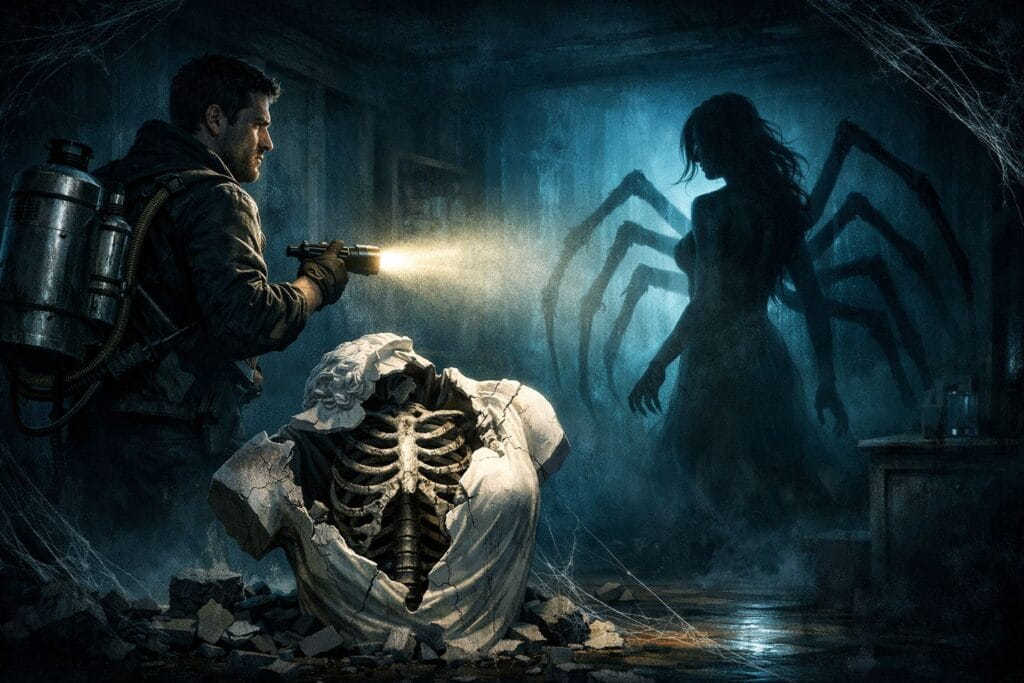
He walked over to one of the Plaster of Paris statues lining the wall. He lifted it effortlessly and smashed it onto the floor. CRASH! The plaster shattered into pieces. From inside the debris, a complete human skeleton tumbled out. Trishna stepped back, feigning shock. “How… how did that get there? I know nothing about this!”
“Stop acting,” D.K. snapped. “We know everything about Brian’s research. Surrender now, or we’ll have to put you in a cage.”
(8)
Trishna sprang to her feet, her eyes blazing. “Fine! I did it! I killed them because I was starving! They satisfied my hunger. And now, you will too. I’ll kill all of you right now, and there will be no proof left!”
Bhargav drew his service pistol. “Don’t make a mistake, Madam. One wrong move and you’re finished.”
Trishna laughed—a chilling, inhuman sound that echoed off the walls. Then, with terrifying agility, she leaped straight up, clinging to the ceiling like a lizard.
Shubho gasped, his heart pounding in his chest. Outside, the faint wail of an ambulance siren drifted by.
Before their eyes, Trishna began to change. Her clothes ripped apart as her body contorted and expanded. Her limbs elongated, snapping with sickening crunches. From her abdomen, rows of hairy, jointed legs burst forth.
Shubho looked at Bhargav; the officer’s eyes were wide with paralyzed horror.
Within seconds, the woman was gone. In her place, a massive, human-sized spider clung to the ceiling. A long, black, fork-like tongue flicked from its mandibles.
“What the hell is that…?” Bhargav stammered, his voice trembling.
The spider scuttled across the ceiling. Bhargav fired a shot, but the creature dodged with lightning speed. It dropped down, wrapping two of its long legs around Bhargav and hoisting him into the air.
From its spinnerets, a thick, rope-like web shot out, wrapping around Bhargav’s throat, choking him.
“Do something!” Bhargav gagged, his face turning purple.
Shubho froze, his blood running cold. The sheer strength required to lift a grown man while clinging to a wall was terrifying.
He shoved D.K. “Do something! Help him!”
D.K. didn’t hesitate. He turned to the two municipal workers standing by the door and shouted, “Start the pumps! NOW! Full force!”
The two men aimed the nozzles of their massive fogging machines at the creature.
HISS!
A thick cloud of white chemical fog erupted from the machines, engulfing the spider.
“Hold your breath!” D.K. yelled at Bhargav. “This isn’t just mosquito repellent! It’s a high-concentration insecticide mixed with an enzyme-blocker!”
The room filled with acrid smoke and the pungent smell of chemicals. The spider shrieked—a high-pitched, ear-splitting sound of agony. The chemical was reacting violently with its biology. Its grip loosened. It convulsed, losing its hold on the ceiling, and crashed to the floor with a heavy thud.
Bhargav fell beside it, gasping for air.
(9)
Shubho rushed forward to untangle the sticky web from Bhargav’s neck.
Beside them, the giant spider lay twitching. Slowly, horrifyingly, its form began to shrink and shift. The hairy legs retracted, the exoskeleton softened. Within minutes, Trishna lay naked on the floor, shivering and gasping for breath.
D.K. walked over and sat on her chest to pin her down, the spray nozzle still aimed directly at her face.
She looked up at him, tears streaming down her cheeks. “Please,” she wheezed. “Don’t kill me. I am a scientific marvel. You can’t destroy a discovery like this.”
D.K. looked down at her with cold eyes. “Any discovery that devours its creator deserves to die. A Frankenstein’s monster has no right to live.”
Without another word, he shoved the nozzle into her mouth and pulled the trigger.
Trishna convulsed once, twice… and then lay still forever.
(10)
A week later, everyone gathered at Shubho’s house. D.K. and Shubho were there, along with Chandrani and Inspector Bhargav.
Bhargav still had bruises on his neck, but he was recovering. Shubho, having shaken off the trauma of that night, finally broke the silence.
“Explain it to us, D.K.,” Shubho said. “How did a living human turn into a spider? I still can’t wrap my head around it.”
D.K. took a sip of his coffee. “Dr. Kevin Neil Brian was a geneticist obsessed with cross-species mutation. Since childhood, he wanted to create a real-life ‘Spider-Man.’ He started experimenting on his assistant, Trishna. He collected DNA from various spider species, but only one specific type matched with her human genes. He succeeded.”
D.K. paused, then continued, “But he forgot one crucial thing: when you change genes, you also change instincts. After the experiment succeeded, Brian trusted her. He became intimate with her. I believe Trishna deliberately seduced him.”
“But why kill him after sex?” Shubho asked.
“Have you heard of the Black Widow spider?” D.K. asked.
“Yes,” Shubho nodded. “The female kills and eats the male after mating. It’s cannibalism.”
“Exactly,” D.K. said. “My theory is that Trishna was spliced with Black Widow genes. That’s why she didn’t just kill her partners—she consumed their flesh and fluids. She stripped them down to the bone.”
“And the statues?” Shubho asked.
“That was the final piece of the puzzle,” D.K. explained. “When I read about Brian’s disappearance, the report said nothing was stolen except research papers and a Plaster of Paris statue. Why steal a statue? You can’t hide a body inside one—it’s too small. But if you strip the flesh and leave only the bones? They fit perfectly. When we found those statues in her room but couldn’t find Raju’s body, I knew exactly where he was.”
Chandrani looked down, her eyes sad. “So… Raju was in one of them?”
“Yes,” Bhargav confirmed. “DNA tests confirmed the skeleton D.K. smashed out of the statue was Raju’s. Another one is likely Dr. Brian’s. Interpol is handling the rest.”
Chandrani handed D.K. a cheque. “Here is your payment.”
“Thank you,” D.K. said.
Bhargav asked, “Who do you blame for this tragedy? The scientist who created the monster, or the woman who committed the murders?”
D.K. sighed, looking out the window. “The scientist acted out of curiosity, not malice. Nobel created dynamite for construction, not war. And Trishna? She acted on a primal instinct implanted in her. She killed to feed, sometimes even in self-defense. Neither is fully a villain.”
He finished his coffee and set the cup down.
“Let’s just call it a terrible accident of science.”
(The End)