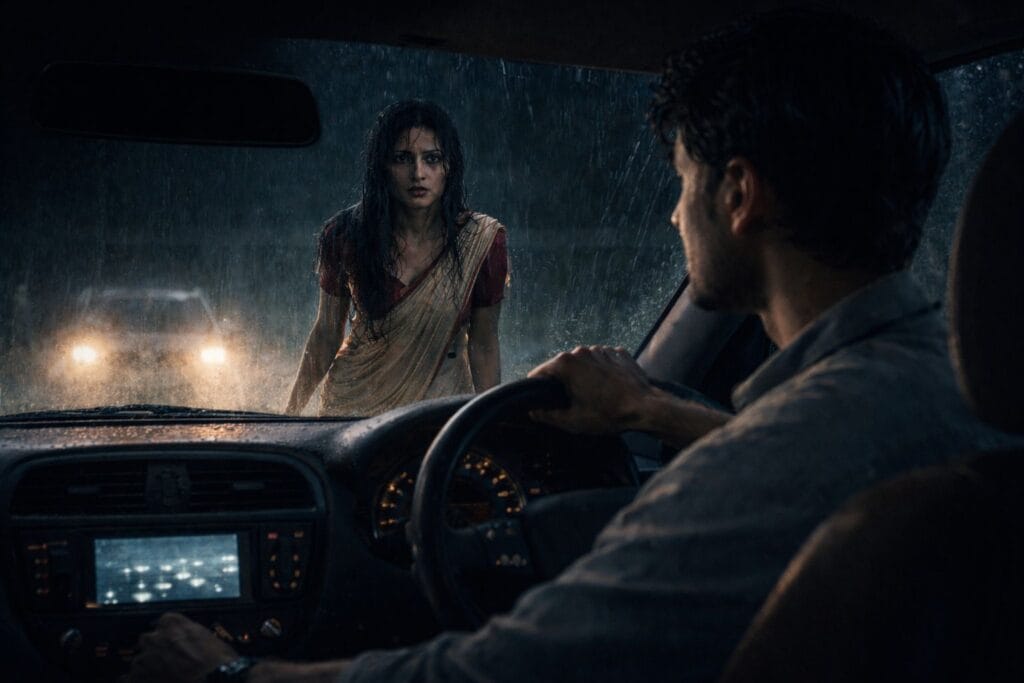
Rahul had become convinced his wife was having an affair.
Baban was just an excuse—a cover for her infidelity. Why else would Mouma slip out of the house every night after he fell asleep?
It started a month ago. Exactly fifteen days after they lost Baban.
At first, he hadn’t noticed. But one day at the office, a colleague pulled him aside. “I saw your wife last night. She was walking down the street in her nightgown. I tried to stop her, but she looked right through me. Just kept walking.”
Rahul felt his blood run cold. Was Mouma losing her mind?
Baban’s death had shattered them both. Their son had been barely eighteen months old, just learning to speak in half-formed words. Though he’d started eating solid food, he still needed to nurse.
Two months ago, they never could have imagined such horror would touch their little boy. No one knew how the snake got into the house—small and deadly, coiled in some dark corner. Baban must have reached for it, curious as toddlers are, and it struck. That night they rushed him to the hospital, his small body convulsing, his screams piercing the darkness. The doctors tried everything—antivenom, ventilation, desperate measures—but the venom had spread too quickly. They couldn’t save him.
The loss had broken something in both of them.
But they were trying to rebuild, trying to move forward. So why was Mouma doing this?
That same evening, Rahul confronted her the moment he got home. “Where did you go last night?”
“To Baban,” Mouma said, as if it were obvious.
Rahul’s heart lurched. “What do you mean? You went to the cemetery?”
She nodded. “My baby was crying. He was so hungry.”
After a long silence, Rahul said carefully, “Mou, you have to understand. Our Baban is gone. He’s never coming back. He can’t cry anymore.”
“You’re the one who won’t understand,” Mouma shot back. “Baban is still here. He’s close to us. Every night he cries with hunger and calls for me—‘Ma, Ma.’ How can I ignore my child?”
The next day, Rahul took Mouma to a psychiatrist. The doctor prescribed medication, but Rahul could see it made no difference. He tried reasoning with her, pleading with her, but nothing worked.
These days, Rahul fell into a deep sleep right after dinner. He suspected Mouma was drugging his food. Then, late at night, she would leave. At first he’d stayed quiet, attributing it to grief—but now suspicion gnawed at him. Was Mouma seeing someone else? People look for comfort in their sorrow. Maybe in searching for that comfort…
He was grieving too, but he’d never thought of turning to someone else. He’d been planning to rebuild their life together.
After this went on for several days, Rahul finally confronted her at dinner, his voice hard. “This nightly habit of yours—it isn’t normal.”
Mouma looked at him with surprise. “What do you think it is?”
“I think you’re having an affair.”
Mouma’s face flushed with anger. “And what if I am?” she shouted. “Will you divorce me? Throw me out?”
Rahul’s temper flared. “If I have to, yes.”
“But you need proof for a divorce,” Mouma said coldly. “You can’t divorce someone based on suspicion alone. Gather your evidence first. Then we’ll talk about divorce.”
Furious, Rahul stormed out to the balcony and lit a cigarette. She was challenging him. Baban was just a facade. Every night she went to meet her lover. She drugged his food so he couldn’t follow. But he was Rahul Mukherjee, and he would expose the truth. If necessary, he’d skip dinner entirely—but he would prove her affair.
That night, claiming illness, Rahul went to bed without eating. Mouma insisted he at least drink some milk, but he refused. He lay still as a corpse, feigning deep sleep. Tonight he would catch her. He would find her and her lover together, prove his suspicions weren’t baseless.
Rahul lay tense and alert. The night deepened around him. The clock struck 1:30. Beside him, Mouma slept soundly, motionless. Her face looked so innocent—it seemed impossible she had anywhere to go. As he waited, frustration crept in. Perhaps she’d sensed his plan and wouldn’t go out tonight.
But suddenly, as the clock struck two, Mouma stirred. She sat up slowly, climbed out of bed, opened the door, and slipped out.
Rahul was startled. He hadn’t imagined she could leave from such a deep sleep. Composing himself, he got up and followed.
Mouma walked unsteadily down the road, swaying slightly. She didn’t seem fully conscious—perhaps sleepwalking. Rahul stayed about ten yards behind. A sense of dread began to build in his chest. Leaving the main road, Mouma turned toward the forest.
Darkness swallowed everything. A half-moon peered through the black sky like a pale eye. The air felt thick, charged with something electric. Trees stood like sentinels on either side. Occasionally birds startled awake, their wings beating frantically.
Suddenly, passing through a patch of shadow, he lost sight of her. Where had she gone? She’d been right in front of him. How could she simply vanish?
Fear gripped his heart. He stood frozen for a moment, then realized where he was.
As a child, he used to take this path when playing hide-and-seek. At the end of the road lay the children’s cemetery. He’d played there with Kalu, Rashid, John, Niyamot, and Rounak. Because children from all three faiths—Hindu, Muslim, and Christian—were buried there, the cemetery had become neutral ground, a place where they could all meet. Those had been good days, until the afternoon when Sudhir-uncle from their neighborhood caught him heading that way. The old man had scolded him severely: “The children who stay in that cemetery—none of them are alive anymore.”
Rahul had never gone back after that.
Was Mouma going to that graveyard? Of course—what better place for a secret meeting? Undisturbed, hidden, somewhere no one would go.
Lost in these thoughts, he stood motionless. Realizing he might lose her trail entirely, Rahul pushed his fear aside and moved slowly toward the cemetery.
The undergrowth rose to his waist. As he walked, he felt unseen eyes watching him from the shadows. Soon he reached the clearing.
In the center of the grounds, he saw Mouma sitting on the ground, her back to him. Something lay in her lap. She was rocking it gently, humming a lullaby.
What was it?
He moved closer. With each step, a horrible chill spread through his body.
Lying in Mouma’s lap was their son Baban—dead for two months.
The flesh had rotted away from his small body after lying underground. Two eyes bulged grotesquely from their sockets. In the moonlight, his gums had receded, leaving his tiny teeth exposed in a permanent grin.
Yet there he was, cradled in Mouma’s arms, nursing at her breast, making wet gurgling sounds that might have been laughter.
Every few moments, he lifted his face and spoke in a voice like wind through hollow bones: “Look, Mummy! Daddy came to see me too! Isn’t it wonderful? Look, Mummy, look…”